- Video Production
- Video Making Tips for Beginners
- How to Make Creative Videos
- How do I come up with creative video ideas
How do I come up with creative video ideas when I feel stuck? Brain Dump First.
Start with a 15-minute brain dump -- write every idea without judging.
Then mind-map connections, flip common niche tropes, reframe topics as audience problems, and add constraints like one location or one minute.
Capture ideas in a notes app or voice memo, and browse other creators only after your own list exists.
Key Takeaways - How do I come up with creative video ideas when I feel stuck?
-
Start by externalizing ideas without judgment. Use a timed brain dump, mind map, or problem/solution list to get every thought out of your head and onto paper or a screen before you start editing or evaluating.
-
Turn raw concepts into shootable plans by narrowing them. Define a specific audience and one core takeaway, then create a simple hook–middle–payoff outline and a shot list of 5–8 simple shots you can realistically film.
-
Overcome perfectionism and slumps by lowering the stakes. Give yourself permission to make bad first drafts, film private test videos, and use constraints like a 15-minute timer or a single location to turn "stuck" into "start."
-
Build a long-term idea bank to stay proactive. Capture ideas immediately in a notes app or voice memo, organize them under 3–5 content pillars, and maintain a simple, honest content calendar to prevent creative emergencies.
- Use external sources for inspiration, not comparison. Treat social media and communities as demand signals by mining them for questions and frustrations your audience has, and look to other fields like photography, film, or nature for fresh creative input.
So how do I come up with creative video ideas when I feel stuck?
I have a confession: while writing this, I felt anxious too. I think you should know that -- because when we feel stuck, it’s easy to think we’re stupid. We’re not.
Feeling stuck is something other people experience too. I experience it. You’re not alone, and you’re okay.
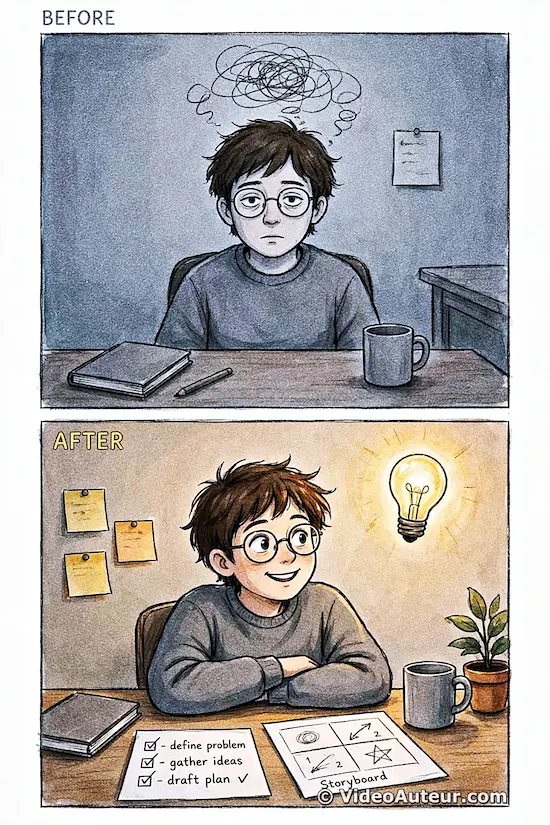
When I feel stuck, it usually means my brain needs a little help from outside myself -- from people, tools, and surroundings. When I get that help, I’m not stuck anymore. That’s what this article is about.
A stuck brain isn’t a broken brain. It just needs a window opened. So take a breath. We’ll figure this out together -- and by the end, you’ll have ways to catch ideas, invite them in, and turn them into something you can actually film.
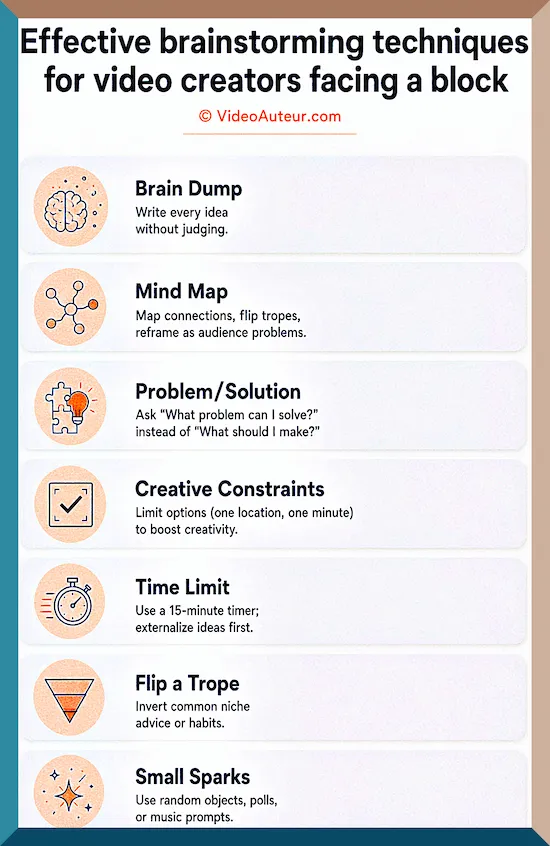
Effective brainstorming techniques for video creators facing a block
Start with a timed brain dump -- write every idea without judging.
Then mind-map connections, flip your niche’s common tropes, and reframe topics as audience problems you can solve.
Add constraints (one location, one minute) and a 15-minute timer.
Externalize ideas first; browse others later.
So what are some effective brainstorming techniques for video creators who face creative block?
Honestly? The most effective techniques all share one thing in common: they get you out of your own head.
Let me explain what I mean.
First, stop editing what doesn't exist yet
I've noticed something about myself when I'm stuck. I cannot do any brainstorming technique if I overthink. I just can't come up with any video idea -- or any idea at all -- when I'm overthinking.
How do I know I'm overthinking? I'm overthinking when I'm trying to edit something that is not yet existing.
Let me explain that.
Let's say I'm trying to... well, move my bowels. (I know, I know. Stay with me here.)
If what I do is hinder the natural process, I'm basically editing something that should naturally come out. What I need to do is let it flow. Let it out. And then clean up the mess. Cleaning up the mess -- that's editing.
I think the same is true for coming up with ideas.
When I need to brainstorm, the number one thing I need to avoid is hesitating, editing, or hindering the ideas that should naturally come.
So before I brainstorm, I remind myself: Don't overthink. Let it flow. Let it out. You don't have to edit yet. You don't have to censor yet.

So how do I actually do that?
Here are the techniques I use when I'm facing a creative block.
1. The Brain Dump
This is my go-to move. Just let it out. Just let it flow. Just dump it.
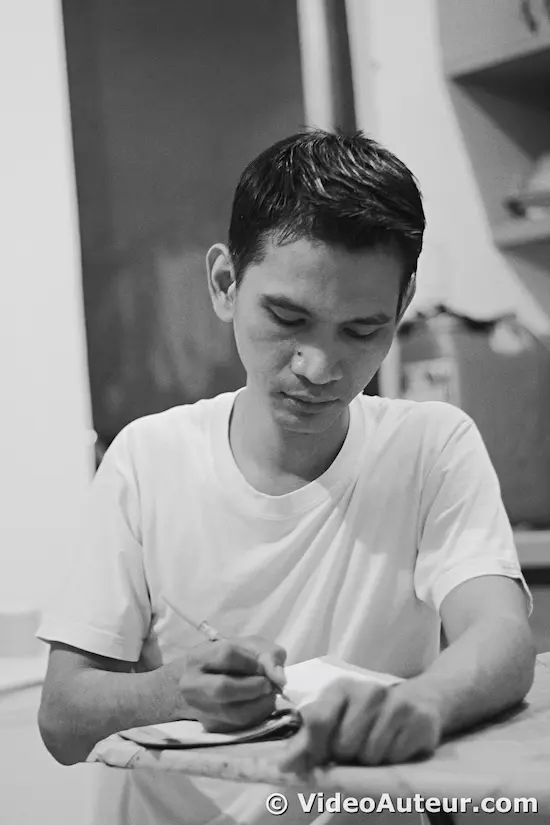
Others call it stream of consciousness. I just list down everything that comes to my mind about the video I'd like to do or the topic I'd like to discuss. No filter. No judgment. Just list down.
Brain dump. That's the key.
2. The Mind Map
After dumping all the ideas, I make a mind map. I put my main theme or niche in the center of a page -- or a digital canvas -- and branch out with sub-topics. Then I branch out again with specific questions, formats, or angles.
I do this on paper, and sometimes with a mind mapping software. But you can absolutely do it on paper with a pen.
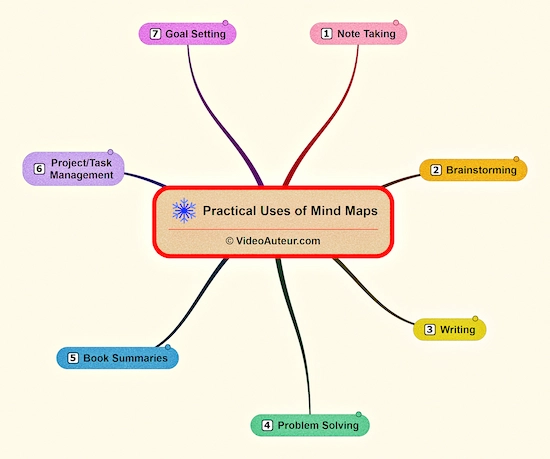
Here's what I notice: when I mind map, I see relationships between my ideas that I would never see if I kept everything inside my head.
Keeping it all in my brain is just another version of overthinking. So I don't overload my brain. I externalize the noise in my head so I can see it, combine it, and pick one thing to pursue.
The point is not to produce a good map. The point is to get it out of you.
3. The Problem/Solution Framework
Beginners often struggle to find topics because they try to invent something entirely new.
But here's the thing: instead of asking "What should I make?" you can ask "What problem can I solve?"
For every problem your audience already has, write a simple video solution. This takes the weight off you having to be "original" -- you just have to be helpful.
What's original is the uniqueness of the solution you offer, not the common problems your audience already has.
How I do it:
- Grab a timer
- Spend 15 minutes listing every problem your audience faces in your niche -- the questions, frustrations, and desires they bring to your topic
- Then spend another 15 minutes brainstorming solutions or video concepts that address those problems
You are no longer asking "What should I make?" You are asking "What problem can I solve?" To me, that's so liberating.
4. Creative Constraints (Yes, Limitations Help)
This one might sound counterintuitive, but limiting your options actually boosts creativity.
Limitations save your brain energy from processing too many options and free your brain to start creating with what you have.
The constraint gives your brain a wall to push against, and pushing against a wall is infinitely easier than pushing against nothing.
Here are some beginner-friendly constraints to try:
- Film a one-minute video from a single spot without moving the camera
- Use only the sounds in the room and no spoken words
- Edit old or leftover footage to a random song and see what story appears
- Make a 30-second video about the object closest to you
- Finish a short video within a week
- Shoot only with one lens (like a 35mm prime on a crop sensor camera)
- Use only a tripod and handheld shooting -- no electronic gimbal
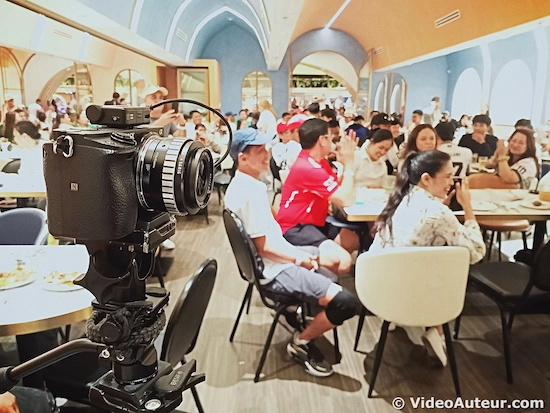 For this relaxed company dinner at a classy restaurant -- not the hectic part of the program -- I shot with a mirrorless camera and a 23mm f/1.4 manual prime (35mm full-frame equivalent). Using a manual prime instead of a zoom was a deliberate creative constraint.
5. Set a Time Limit
I don't brainstorm forever. I set a timer. Let's say 15 minutes for listing down any ideas related to a video I'm proposing to make.
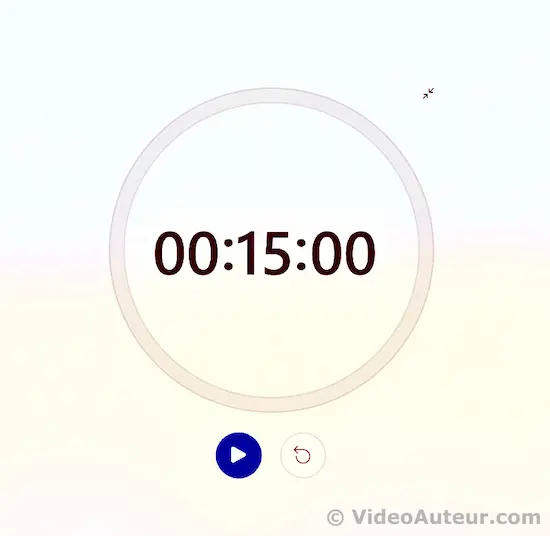
Whatever I write in those 15 minutes -- that's it. Then I take a break.
That kind of creative constraint helps me really come up with ideas because my mind is now guided to focus on this activity and not be distracted by social media or phone notifications.
So when I do this session, I make sure the internet is off, notifications are off, and I just list down anything that comes to mind for a certain period of time.
And here's what's funny: after the 15-minute session, ideas continue to occur to me. So I keep a pen and paper -- or a note-taking app on my phone -- with me.
Whatever comes to mind when I'm doing other things, I just write it down. It's another form of brain dump. I'm trying to have a net that will capture those ideas.
6. Flip a Common Trope
Choose a common piece of advice or habit in your niche and flip it.
If every video on your topic is a "10 tips" list, what would a "the one thing I'd stop doing" video look like? If most are fast and loud, what happens when yours is slow and quiet?
When I do this, it's not about being the opposite of everyone else just to be a rebel without a cause. I simply want to see things from angles others might not normally see from. It's about being curious and open like a child.
I don't always need to reinvent the wheel -- I just want to notice what others might be overlooking. Flipping a trope gives you a fresh angle without requiring you to invent a whole new subject.
7. Small Sparks: Everyday Objects, Random Prompts, and Polls
You can also try these fun, lighter approaches:
- Open a book or dictionary to a random page, pick two words, and ask what video could connect them
- Ask classmates, friends, or followers a two-option question: "Which would you rather watch, A or B?" It takes a minute and removes a lot of guesswork
- Look back at your best-received video. What question did it leave unanswered? That question is your next video
- Edit a short sequence to a piece of music you already love, without planning the shots first
A Gentle Reminder Before You Scroll
One practical takeaway I want to leave you with: do your brain dump first, browse other creators second.
That way your own thoughts are already on the page before anyone else's ideas arrive.
A video idea becomes much less intimidating when it has a person, a problem, and a small useful outcome.
You don't need to be brilliant. You just need to start -- and let it flow.
How do you turn raw concepts into concrete, shootable videos?
Turn a raw concept into a shootable video by narrowing it: name one viewer and one takeaway, sketch a hook–middle–payoff outline, then write 5–8 simple shots you can actually film this week with your current gear.
Simplify until you can press record.
So how do I turn my ideas into concrete, shootable videos?
Here's the honest answer: the bridge from concept to production is not a creativity problem -- it's a pre-production problem. And like most pre-production problems, it has a procedure.
I have great ideas for videos. But they are just that. Great ideas. They become useless if I cannot use them in the real world to make my own videos. I need to find ways to translate my concepts into something I can actually shoot.
Here's where a lot of beginners get a second wave of stuckness. You've done the brain dump. You have a messy list of half-ideas. But none of them feel like a video yet.
That's completely normal. Let me walk you through how I bridge that gap.
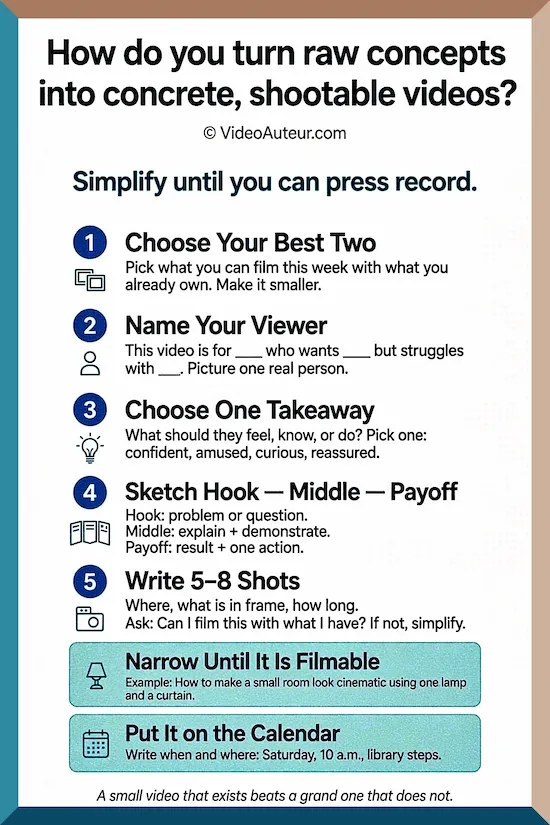
Step 1: Choose Your Best Two (and Be Realistic)
Circle two ideas from your list. Favor the one you could film this week with what you already own.
A "Part 2" of a successful video, a deeper sub-topic from something that already worked, or a re-tackle of a video that flopped for execution reasons are all legitimate starting points.
The goal of this step is not to make the video feel bigger. It's to make it feel smaller -- small enough that you can actually press record.
Step 2: Name Your Viewer
Before I write a shot list, I answer two questions in one sentence each: Who is this for, and what do I want them to feel or know by the end?
Finish this sentence: "This video is for who wants but struggles with ___ ."
Picture one real person -- like a classmate or a cousin -- rather than "everyone."
Knowing your intended viewers is so powerful because it serves as a filter for everything else that is not going into your video.
Step 3: Choose One Feeling or Takeaway
Video is not something you simply read like a book. Video is an experience. Viewers can see what's on the video, hear what's on the video, and feel almost a tactile experience. Video doesn't just carry a message -- it carries emotion.
So after watching, what should your viewer feel, know, or do? Pick one: more confident, amused, curious, reassured.
One clear takeaway is much easier to film than five.
Step 4: Sketch a Simple Three-Act Outline
You need a beginning, a middle, and an end -- or, in practical terms, a hook, a payoff, and a close.
- Act One (The Hook): Show the problem or result first. Ask the question.
- Act Two (The Middle): Explain the idea while demonstrating it. Where you try, explain, or explore.
- Act Three (The Payoff): Show the result, give one actionable takeaway, and invite a response.
Three sentences are enough. This simple structure becomes the frame -- the container -- for all the shots you're going to brainstorm next.
Step 5: Write a Short Shot List
Here's where the magic happens.
What do I do with that simple three-part structure? It becomes the guide for the kinds of shots I'm going to brainstorm.
This is crucial because you're now thinking in terms of what the audience will see and what they'll hear and what they'll experience.
How do I come up with my shot list?
I do the same thing I did with ideas. I write it down. I record what comes to mind using a voice recorder. I use pen and paper. I use a digital note-taking app. I capture everything.
Then I ask: Are these shots usable?
My criteria is simple: the concept, the message, my audience, and the topic of the video. Those are my filters for relevance.
So the first thing is I just spit it out -- list all the shots that occur to me -- and then judge them later according to relevance.
The good thing is you're not staring at a blank page. You have material to work on. You can sort them later and choose from your best ideas.
Write 5 to 8 shots: where you'll be, what's in the frame, and roughly how long each lasts. Then ask honestly: "Can I film this with what I have?" If not, simplify until the answer is yes.
A small video that exists beats a grand one that doesn't.
A Simple Pre-Production Roadmap
Here's a table you can use to organize your thinking:
| Step | What to Decide | Example |
|---|---|---|
| Audience | Who is this for? | Beginner phone filmmakers |
| Core Takeaway | What should they understand or feel? | “Good lighting matters more than an expensive camera.” |
| Promise | What will they be able to do afterward? | “Improve an indoor video using one window and a white wall.” |
| Structure | What happens first, middle, and last? | Problem, demonstration, before-and-after |
| Minimum Shoot | What footage is truly necessary? | Three shots: messy lighting, fixed lighting, final result |
Narrow Until It's Filmable
If your idea is "budget filmmaking tips," narrow it until it is filmable: "How to make a small room look cinematic using one lamp and a curtain."
That is specific enough to plan shots, but open enough to leave room for discovery.
Put It on the Calendar
Write down when and where you'll shoot. Something like "Saturday, 10 a.m., library steps."
Here's why this matters to me: unfinished goals and tasks keep intruding on my mind and can interfere with unrelated tasks I'm currently doing.
But making a specific plan -- or at least writing down my thoughts on what I'll do about it -- eliminates those effects. It helps my brain stop circling.
It doesn't melt every nervous feeling or worry I have, though. But I have fewer intrusive thoughts, knowing that those nagging thoughts are "noted" so I can go back to the task I'm currently doing.
One More Thing
Remember what I said earlier about not overthinking? One reason for that is I don't want to get overwhelmed.
So every idea -- I capture it. I write it down either on paper or a digital note-taking app. Or I record it using my phone's voice memo. I capture everything related to a proposed video of mine.
A creative spark is not yet a video. The next step is to translate it into something you can realistically film with the time, equipment, and energy you have today.
For that full step-by-step -- from outline and shot list to edit and export --
You don't need to be brilliant. You just need a container -- and the courage to start small.
When you are in a creative slump, what do you do to get the juices flowing?
Accept the slump, then move: take a short walk or bike ride and capture ideas as they come.
Rest without guilt, hydrate, and pull inspiration from photography, film, music, or nature.
Skip comparing yourself to other creators -- make space for ideas instead of forcing them.
So when I'm in a creative slump, what do I do to get my creative juices flowing?
Here's the short answer: I stop trying to force it. I accept the slump. And then I gently invite ideas back in -- through movement, rest, and cross-disciplinary inspiration.
It took me a while to get here. But I've learned that sometimes the most productive thing you can do for your creativity is to stop trying to be productive.
Let me walk you through what actually helps me.
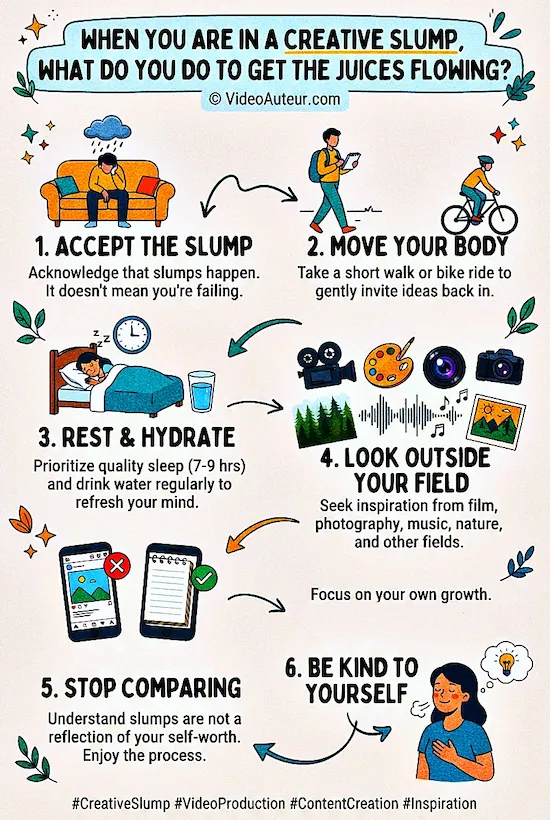
First, Accept the Slump
One thing I've realized is that when I'm in a creative slump, I need to accept that I will -- from time to time -- experience creative slumps.
Why? Because I believe that I myself am not the absolute source of all ideas.
I'm not saying this to degrade myself. I've just accepted the fact that I am just me. A humble human being who needs to connect to other things, to forces greater than myself, in order for ideas to start flowing through me.
It's like this: I imagine myself as a conduit. A tube where water flows. I am not the absolute source or well of water -- or ideas. They just start flowing through me.
But how do I get them flowing?
Move Your Body
And then while I'm walking, I have my pen and paper or my smartphone. While I'm walking, I start thinking about the task I'm going to do or the video I want to make. And somehow, some way, ideas start coming to me.
Even when I'm not actively thinking about the project. Let's say I'm eating dinner. And then ideas will come. And I capture them so I have material to work on later.
So that's one thing I do. I get up, I start walking, and ideas start flowing. (There's interesting scientific research on walking and how it affects creative thinking -- I'm not imagining this!)
Another similar experience: riding my bicycle. I'm not riding to do sprints or race or compete with other cyclists. No. I just ride my humble bicycle calmly, in a leisurely manner. I stay in the slow lane to keep myself safe, and I start thinking about the project. When ideas come, I capture them.
 Slow bike rides help me generate ideas and insights for video projects I’m planning or working on -- and for other creative work, like writing, not just video. Photo of me by Mariel Motilla.
A simple rhythm to try: walk to generate ideas, then sit to choose among them.
Rest Without Guilt
Here's something I do especially when I'm tired: I listen to my own mind and my own body.
I don't force my brain and body to keep working while they're telling me they need a break. They need to rest.
So one thing I do is take breaks. Take rest.
Actually, when I'm in a deep work session, I try to stand up every 30 minutes. I walk or do some stretching, drink some water. That gives my brain and body some refreshment, and then I continue working.
When I feel really tired for the day, I take a rest. I don't force my body because it's counterintuitive. I won't be able to make quality work anymore. I cannot get creative ideas anymore if I just force myself and ignore the truth that I need rest and sleep.
 My wife took this photo of me sleeping while we were on vacation in her province. Posting it here. :-)
And when it comes to sleeping: I aim for at least six hours. Ideally, seven to nine. But usually seven. Because in my experience, if I have enough sleep -- say seven hours -- when I wake up I'm really refreshed. My head is not heavy. Unlike when I only have four hours of sleep. Then my head is heavy and everything feels harder.
When I have enough sleep, I'm able to continue working. Continue doing creative work for my videos.
So really, I think you just have to listen to your own mind and your own body. Be true to yourself. Be true to your capacity.
Sometimes the most productive thing you can do for your ideation is to stop consuming and let your brain be quiet. When my mind and body feel rested, my whole being is recharged and I'm ready to start my engines of creation again.
Look Outside Your Field
So what are the other things I do to get creative ideas flowing?
Well, I know I'm in the field of video making. Video creation. Video production. But I don't stay in that field. I look elsewhere.
Here's where I draw inspiration:
-
Filmmaking and cinematography. There are differences in how visuals are shot in videography versus cinematography. For example, in video, it's often about using autofocus. But in film, cinematographers prefer manual focusing because it's about more control. It's about being more human -- the human itself is doing the focusing. So I get inspiration from filmmaking even though I'm in video production.
-
Photography. Photographers are known for really paying attention to the focal lengths of the lenses they use. They don't just shoot -- they choose deliberately what lens to use. I'm influenced by the best practices of great photographers like Henri Cartier-Bresson and others.
-
Beautiful paintings. Especially the way images are framed and composed. I apply those concepts to video making. It doesn't matter what kind of painting -- an impressionistic piece, a Caravaggio, or paintings from the Baroque era. I draw inspiration from these beautiful works.
-
Foley artists. Video creation is composed of images and sounds. So I pay attention to how foley artists do their work -- how they pay close attention to sound. I want my audio to be clear and consumable for the ears.
- Music. I listen to a lot of instrumental music because musical pieces carry emotions. Music is used a lot in video creation -- it contributes to the mood and emotion that a video brings to the audience. So I feel the music, whether instrumental or with lyrics. I draw inspiration from it.
A particular benefit I get from experiencing other art forms is that pleasurable feeling. It refreshes me and can also be a source of ideas for a video project. Or at least -- that feeling -- I become curious about how to translate that to video in some way.
- Nature. To me, nature doesn't just give me ideas -- it nourishes my body, mind, and soul. Feeling connected to nature helps me perform better and do my tasks better.
 Photo of me by Jessica Motilla.
I'm being nourished by the best system I know in the universe: nature.
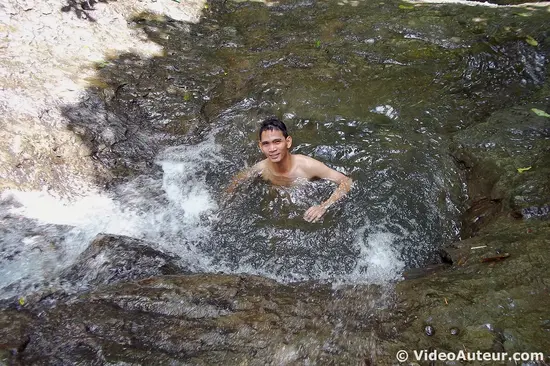 Me bathing in a small waterfall. Photo by Jessica Motilla.
Unlike the many systems that humans build for other humans -- systems that sometimes take too much from you and give very little in return -- nature is not like that.
 My wife Jessica caught me in a meditative mood by the sea and took this photo.
Nature really nourishes and gives me the things I want and need in my life and in my work.

Stay Hydrated
This might sound small, but it helps my brain: I make sure to drink clean water every hour. I keep myself hydrated -- and that includes my brain. It's easier for me to think and operate when I'm hydrated.

How about you?
Never Compare Yourself to Other Creators
One fair warning I always give myself: never compare myself to other creators or other people.
Why? Because that will just make me feel bad about myself.
I am not supposed to compare my beginner self to someone who is already at their expert level. I am here to grow, to learn, to get ideas, to do what I need to do.
Making unnecessary comparisons to other people will just take so much energy from me. I'm now focusing on other people instead of focusing on myself -- to enrich myself and help myself grow.
So fair warning to you also: don't compare yourself to other people. Yes, there are people around. You can learn from them. You can even collaborate with them. But don't compare your beginner self to their expert self, or whatever level they may have.
There's a crucial difference between inspiration and comparison. Scrolling the feeds of creators who are further along than you is not inspiration -- it's often just a live demonstration of everything you think you're failing at. Social media is so good at making people feel that toxic overlay of competition. So be selective about what you consume from social media.
Deliberately choosing inputs from outside your niche -- a photography book, a walk without headphones, a piece of music you love -- gives your brain raw material without the toxic overlay of competition.
Making unhealthy comparisons just hinders me from getting my creative juices flowing. So I keep quiet, and I do my own thing.
A Gentle Reminder About Self-Worth
Here's something I hope I learned earlier -- and I hope it helps you too:
Whenever I experience a slump or burnout, it is never a reflection of my self-worth. (You and I are inherently valuable.) It just means that as a creative human being, I also get tired because I am made of flesh, blood, and bones.
I just need some rest. I believe everybody needs it too -- it's a universal need, part of human nature. Anyone who goes against what's already programmed in nature just experiences worse.
So I've learned to accept and embrace both my strengths and weaknesses -- my human nature. I hope you do too. I hope we become kind to our own selves.
One Last Thought
Creative work can become emotionally expensive when it's constantly tied to output, comparison, and visibility.
So I think it's better to just enjoy and love the creative process -- to care for my work and my audience -- because that is something that's under my control.
But I never attach myself, my happiness, and my sense of self-worth to the outcome or result. The result is something I may have influence over, but I don't have absolute control over it because there are many outside factors affecting it.
Be kind to yourself. Rest when you need to. Move when you can. Look outside your field for inspiration. And remember -- the ideas will come. You just need to make space for them.
What can you do when you have video ideas, but lack the drive or face perfectionism?
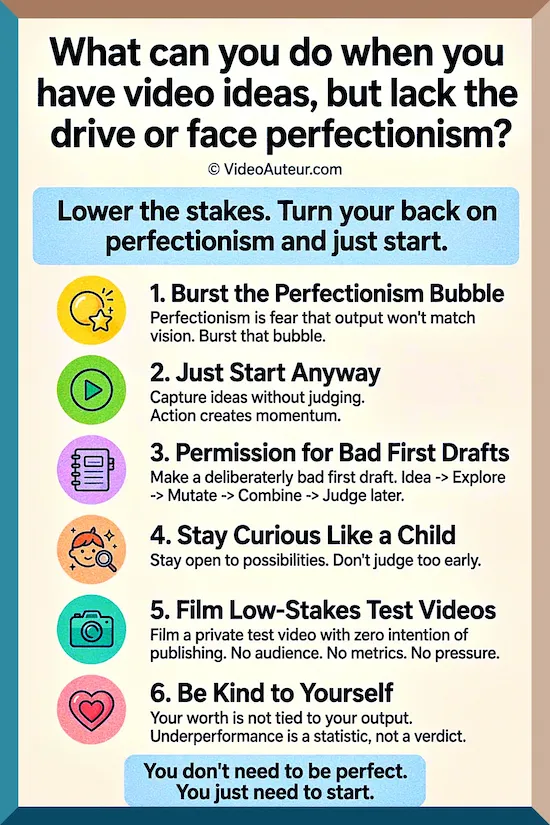
Lower the stakes.
Turn your back on perfectionism and just start: capture ideas without judging, make a deliberately bad first draft or private test video, then refine as you go.
Action creates momentum, and permission to make mistakes replaces the missing drive.
So you have video ideas, but you lack the drive -- and perfectionism is standing in your way?
Here's the short answer: turn your back on perfectionism. Face the other way. And then just start anyway.
I know that sounds almost too simple. But let me explain what I mean -- and what I actually do when I find myself in that same spot.
First, Burst the Perfectionism Bubble
When I face that similar experience, the thing I do is really not bother with perfectionism.
What I mean is: I don't try to live in a fantasy world where everything I think of and do is perfect. A world where nothing has any flaws or mistakes. A world where nothing can be improved anymore because everything is so pristine and perfect.
I don't live in that kind of fantasy world. So I burst that bubble.
Perfectionism, at its core, is the fear that the output won't match the vision in your head. And that fear can keep you frozen indefinitely.
This is a different flavor of stuck: the ideas exist, but the distance between the idea and the finished video feels impossible to cross.
If you have video ideas and you face perfectionism -- just turn your back on it. Face the other way.
Just Start Anyway
In my experience, I just start. I just do it anyway.
And then -- in the process of doing it -- just like when I walk and continue to walk, I notice things I wouldn't be able to notice if I just sat. Along the way, I see improvements for my initial ideas. It becomes clearer to me what to do next.
And that won't happen if I don't start.
So just start.
Here's what that looks like in practice:
- Have your notebook or pen and paper ready. Or your smartphone with a voice memo app. Or your digital note-taking app.
- Write down your thoughts. Capture them.
- Without judging them. Just capture them.
- Be kind to yourself and be kind to your initial ideas. Because later, you will sort them and choose among them -- which ones will you use for your video.
And when it's time to make your outline or script? Just do it.
You have permission to make mistakes at first. You have permission to put out something that is not yet great. Because as you do it, it becomes better.
Give Yourself Permission to Make Bad First Drafts
Not "good enough" drafts. Bad ones.
Keep a judgment-free notebook or a voice memo folder where ideas are allowed to be terrible.
Here's the thing about judgment:
When judgment arrives too early, the sequence is Idea --> Judge --> Reject. And what happens? You never produce anything. Not quite the result you want, right?
But when you create a little room for play, the sequence becomes Idea --> Explore --> Mutate --> Combine --> Judge later.
The bad draft is not the enemy of the good video. It is the precondition for the good video. Why? Because there's always room for improvement.
Stay Curious Like a Child
Instead of aiming for perfection or greatness from the outset -- I forget about that.
The mindset I have is this: whether I'm coming up with video ideas, structuring the outline or script, or when it's time to shoot videos -- I just stay open. Open to possibilities. And curious, just like a child. Maybe like a toddler who is curious about her surroundings.
 My daughter Mariel. :-)
And it pays off, because you're not judging yourself. You're just being open. Like a sponge that is ready to absorb any liquid that is poured into it.
So I stay curious. Open to possibilities. Open to making connections between the ideas and the shots that I have.
I think that is where your drive will come from. It will come from staying curious and open -- and just really showing up in the process.
Film Low-Stakes Test Videos
This is one of the most underrated unblocking tools available to beginners.
Film low-stakes test videos with zero intention of publishing them.
A test video has:
- No audience
- No metrics
- No comments
- No possibility of public failure
You are your own audience. You are doing this for yourself.
You are filming to remember how your camera works. To practice a cut. To see if an idea has legs. The moment you remove the pressure of an outcome, the resistance often evaporates.
You are not "making content." You are playing.
And isn't that fun? There are many reasons to be happy.
Be Kind to Yourself
This is also where the emotional reality of being a beginner -- and even an experienced practitioner -- deserves to be named.
If the content underperforms, it's not a personal verdict. It's a statistic that can change. Never tie your identity to an output that is still in its learning phase.
And if you're an experienced practitioner already -- the same is true. We continue to learn, grow, and improve as long as we live.
This is something I always remind myself, my daughter, and my wife. We always remind ourselves to be kind to ourselves.
So I urge you to be kind to yourself as well.
A Gentle Recap
When you have ideas but lack the drive or face perfectionism:
- Turn your back on perfectionism. Burst the bubble.
- Just start anyway. You'll notice things along the way that you wouldn't see if you stayed still.
- Give yourself permission to make bad first drafts. That's the precondition for good work.
- Stay curious and open like a child. Don't judge too early.
- Film low-stakes test videos with no intention of publishing.
- Be kind to yourself. Your worth is not tied to your output.
The drive will come from showing up. From staying curious. From playing.
You don't need to be perfect. You just need to start.
How can you use popular content platforms and online communities to spark fresh video ideas?
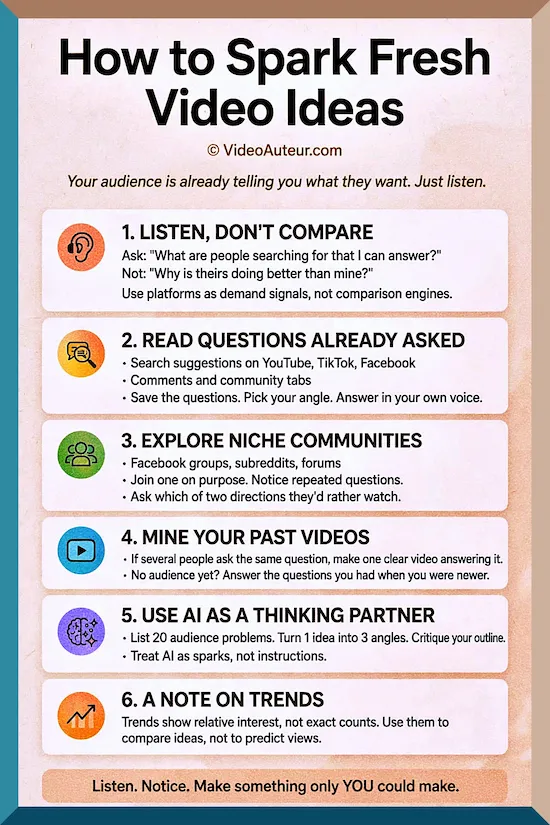
Treat social platforms as demand signals, not comparison engines.
Check search suggestions, comments, community tabs, subreddits, and Facebook groups for repeated questions.
Save those questions, pick your angle, and answer them in your own voice.
This gives beginner-friendly ideas grounded in real audience curiosity.
So how can you use popular content platforms and online communities to spark fresh video ideas?
Here's the short answer: your audience is already telling you what they want to see. You just have to listen.
A while ago, we talked about getting ideas from your own thoughts, experiences, observations, and surroundings -- from related disciplines like photography, filmmaking, music, even painting.
But now we're talking about getting video ideas from content platforms like social media and other communities online.
You can use social media as a brainstorming partner. And the key is to use these platforms as demand signals, not as comparison engines.
Let me explain what I mean.
The Difference That Changes Everything
There's a big difference between asking:
- "What are people searching for that I can answer?"
- "Why is this person's video doing better than mine?"
The first question is a brainstorming tool. The second is a recipe for paralysis.
So as we go through these techniques, keep that first question in mind. We're here to listen, not to compare.
Read the Questions Your Audience Is Already Asking
What I notice is that people are asking questions in the comment sections of social media platforms and video hosting platforms. Those questions reflect what people want, what they'd like to see, and what they'd like to learn about.
In your case, you can use those questions or requests as a source of video ideas.
Here's how:
-
Search suggestions. Type the start of your topic into the search bar on YouTube, TikTok, or Facebook. Notice the suggestions that appear. Those are clues about what people are searching for right now. Treat suggestions as clues, not guarantees -- but they're a great starting point.
-
Comments and community tabs. Look at videos on your topic and read the comments. You'll see people asking questions related to your topic. Those are ready-made video questions.
- Questions, not copies. Save the questions people ask. Then ask yourself, "What's my angle?" You're not copying -- you're answering in your own voice.
This is one of my favorite ways of getting video ideas because people on social media are already doing the talking. Those questions and requests are coming from real people. You're not speculating -- you're just mining data from social media and video hosting platforms.
Explore Niche Communities
Look at other online communities like Facebook groups or Reddit threads. There are people asking questions about specific topics or niches. Those are ideas for videos you can make.
Niche forums, subreddits, clubs, and group chats can all be wonderful sources of ideas.
Here's a gentle approach:
- Join one community on purpose.
- Read to notice the questions people ask.
- Share a rough idea, and ask which of two directions they'd rather watch.
- Choose communities that feel kind. If a space leaves you feeling smaller, it's completely okay to leave.
Mine Your Own Past Videos
Don't forget to look at your own content.
Which comments, questions, or moments could become a follow-up? What question did your best-received video leave unanswered? That question is your next video.
A simple rule: If several people ask the same question, make one clear video that answers it.
And if you don't have an audience yet? Answer the questions you had when you were newer. Your past confusion is often someone else's current problem.
Use AI as a Thinking Partner (Not an Idea Vending Machine)
AI can help you move from a blank page to a first draft, but it should not replace your perspective.
Here are some ways to use AI as a thinking partner:
- Ask it to list 20 audience problems in your niche
- Ask it to turn one rough idea into three different video angles
- Ask it to identify assumptions in your idea that may not match a beginner's experience
- Ask it to create a shot list -- but replace generic suggestions with your own locations, objects, and voice
- Ask it to critique your outline for clarity, not to write the entire video for you
AI-generated ideas can be inaccurate or vary in quality, so treat them as sparks rather than instructions.
A Note on Trends
Trends reports show relative interest, not exact search counts. Use them to compare ideas, not to predict views. They're a tool for curiosity, not a crystal ball.
One Gentle Reminder
When you feel creatively empty, external signals can act like a quiet brainstorming partner.
The goal is not to copy trends. It is to notice the real questions, frustrations, and curiosities around you -- and then answer them in your own voice.
Once your own ideas are on paper, outside signals can act like a quiet brainstorming partner. How do I come up with creative video ideas when I feel stuck? One answer is to listen to what people are already asking, and then answer it in your own voice.
So listen. Notice. And then make something that only you could make.
How do you consistently build a long-term idea bank so you never run out?
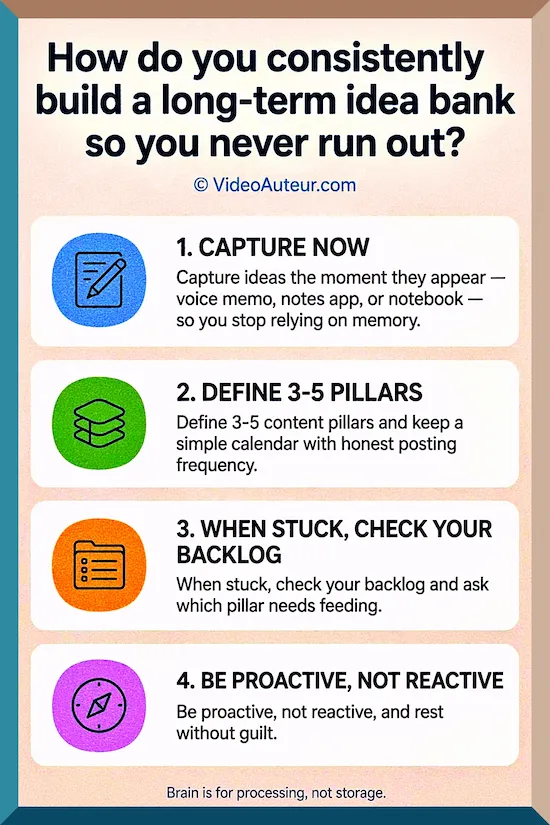
Capture ideas the moment they appear -- voice memo, notes app, or notebook -- so you stop relying on memory.
Define 3–5 content pillars and keep a simple calendar with honest posting frequency.
When stuck, check your backlog and ask which pillar needs feeding.
Be proactive, not reactive, and rest without guilt.
So how do you consistently build a long-term idea bank so you never run out?
Here's the short answer: you stop answering the question "How do I come up with creative video ideas when I feel stuck?" in the moment of crisis. Instead, you build a system that prevents the crisis from happening in the first place.
In short: be proactive, not reactive.
That's also a piece of advice I remind myself, my wife, and my daughter for navigating life in general.
Let me walk you through what that looks like in practice.
First, a Gentle Reminder About Consistency
I have to admit -- I need to remind myself about being consistent too. And after reminding myself, I just try to show up in the process.
Building a long-term idea bank so I never run out or get exhausted? Well, with regard to running out of ideas, the way I see it is this: ideas are really everywhere. I just have to notice them and see how they connect to something -- some video -- that I'd like to create.
It's about noticing, and then reacting to the stimulus.
And for the long-term idea bank? That's where a system helps.
Create an Idea Capture Habit
The first step is building an "idea capture" habit.
Keep a small notebook or a notes app on your phone. When you're in the shower, walking to class, or waiting in line -- write down anything that catches your interest. A weird conversation. A funny observation. A question you just had.
The key is to capture it. Not "later." Now.
A voice memo. A note. A screenshot. The medium doesn't matter. What matters is that you stop relying on your memory to hold creative material.
I myself don't trust my own mind and memory. I've accepted the reality that I can forget things. So I don't solely rely on my own understanding.
Most creators don't have an idea shortage -- they have a retrieval shortage. The ideas were there, but they weren't written down.
To me, my brain is not mainly for storage. It's for processing. It's so hard to process something well when my mind is overloaded or anxious. So I capture promising thoughts and ideas.
Here's what I use:
- Voice memos or a notes app for quick idea capture
- A notebook for when I want to write by hand
- Obsidian for my long-term idea bank -- you can install it on your phone or laptop and organize your ideas there
Pick a single notes app (plus voice memos) on your phone. When an idea shows up in the shower or on the bus, capture it right away.
But don't rely on any single tool's memory. Keep a copy of your best ideas somewhere that's truly yours.
Build a Pillar-Based Content Calendar
The #1 reason creators quit isn't a lack of talent -- it's decision fatigue.
To combat this, define three to five "content pillars" -- broad topics you love talking about.
For example, a student creator might have pillars like:
- Study Tips
- Campus Life
- Tech Reviews
When you have a structured calendar with these pillars, you aren't deciding what to post every day. You're just deciding which pillar fills the slot for that week.
This eliminates the bottleneck of daily decision-making and allows you to batch-film content in a single session.
When you're stuck, you don't ask "What should I make?" You ask "Which pillar haven't I fed recently?"
The calendar is not a cage. It's a map you drew for yourself when you were calm, so that the stuck version of you has somewhere to go.
Be Honest About Your Schedule
Here's the thing about content calendars: be really honest about the frequency of your scheduling or posting.
If you cannot do it daily, don't do it. Maybe at most you can upload or schedule videos once a week. But any schedule will help you. You just have to be honest.
And what helps in consistent scheduling is consistent production. And just continuously showing up in the process.
The key word here is being proactive -- especially if you have a social media channel where you need to consistently post your video content.
Here's the chain:
- To be proactive, you have to schedule.
- To be able to schedule, you have to consistently produce.
- To be able to consistently produce, you have to consistently come up with ideas.
So being proactive is really about preparing. Looking ahead. Asking: What's going to happen in the future? What would I like to do in the future? And then preparing. And then doing it.
Don't Be Hard on Yourself
Don't be hard on yourself if you're not able to post so consistently. It's okay. There are other things in our lives that happen.
Being proactive doesn't mean being perfect or always being able to post new videos. Just doing it is enough. Just showing up in the process.
And then if you have to rest -- rest. Because our body needs to rest as well. Take care of yourself. Take care of your body and your mind. So you'll be able to produce more and create more.
Creating content that engages people, being happy with the process, and really caring about our audience -- that's what will keep you going.
A Simple System
A sustainable idea bank does not need to be beautiful.
30 messy lines is more valuable than a perfect spreadsheet you never open.
The goal is not to never feel stuck again -- that's not realistic. The goal is to have a backlog of concepts and a capture habit so that when you do feel stuck, you have somewhere to look besides the ceiling.
The best cure for "I have nothing to make" is often a backlog made during the days when you do have ideas. Creativity is easier to sustain when it is captured consistently rather than summoned in a panic.
So create a simple system.
A Gentle Recap
To build a long-term idea bank:
- Capture ideas immediately. Don't trust your memory. Use voice memos, notes, or an app like Obsidian.
- Define 3-5 content pillars. When stuck, ask "Which pillar haven't I fed recently?"
- Build a simple calendar. Be honest about your frequency. Weekly is fine. Consistency matters more than volume.
- Be proactive, not reactive. Prepare for the future instead of scrambling in the moment.
- Be kind to yourself. Rest when you need to. Show up when you can.
The final shift is from reactive troubleshooting to proactive system-building.
You don't need to be perfect. You just need a system that catches your ideas -- and the kindness to keep showing up.
Frequently Asked Questions
How do I come up with video ideas when nothing seems obvious?
How do I come up with video ideas when nothing seems obvious?
Start with problems, not topics.
List three frustrations your audience has in your niche, then list one video solution for each.
The obvious idea is often hiding inside a question you've already heard someone ask.
Struggling to come up with video ideas, help?
Struggling to come up with video ideas, help?
Lower the stakes before you raise the effort.
Do a five-minute brain dump with no filtering, then pick the single most shootable fragment and make a thirty-second test video with no intention of publishing it.
Momentum matters more than quality at this stage.
How do you consistently come up with good, original video ideas?
How do you consistently come up with good, original video ideas?
Originality is a byproduct of combination, not invention.
Feed your brain inputs from outside your niche, capture ideas immediately in a phone note, and organize them under recurring content pillars so you always have a backlog to draw from.
Consistency comes from a system, not from a mood.
What do you guys do when you can't come up with video ideas based on your niche?
What do you guys do when you can't come up with video ideas based on your niche?
Change the input.
Watch a video from a completely different field, take a walk without headphones, or ask your audience directly what they're struggling with.
If you're still dry, revisit your best-performing video and make a deeper sub-topic or a "Part 2" .
Your past work is a goldmine for future ideas.
Conclusion
So, how do you come up with creative video ideas when you feel stuck?
The journey through this article has shown us that the answer isn't a single lightning bolt of inspiration, but a series of gentle, practical steps.
We've explored...
- how to quiet the inner critic to let ideas flow,
- how to translate those raw sparks into a concrete filming plan, and
- how to build a sustainable system so you're never starting from a blank page again.
The real lesson is that feeling stuck isn't a reflection of your talent; it's a signal to change your approach. It's an invitation to...
- move your body,
- rest your mind,
- look outside your field, and
- listen to the questions your audience is already asking.
You've learned that the most powerful tool is not a perfect idea, but a simple system for capturing the imperfect ones.
Most importantly, this article is a reminder to be kind to yourself. The goal isn't to eliminate creative slumps but to build the resilience and the tools to navigate them with less fear and more curiosity.
You don't need to be brilliant or perfect. You just need to start, capture what comes, and trust that by making space for ideas, they will find you.
Which of these small, practical steps will you try the next time you find yourself staring at a blank page?
You might like these
Ready to tell your story? Learn video production for beginners!
Learn free video production tips from Video Auteur! Discover the art of video creation. Craft your engaging piece.
Video Making Tips for Beginners: Start Creating Today
Video Making Tips for Beginners: Overcome overwhelm and start creating. Practical tips on content, audio, framing, editing and finding your voice.
What Is an Auteur? Find Your Unique Creative Voice
What Is an Auteur? It's your inner creative voice. Learn how to unleash it through self-discovery, studying inspiring creators, and consistent practice.




Alvin Motilla is the creator of VideoAuteur.com, where he helps everyday people make videos that truly connect with audiences. With over 20 years of experience spanning scriptwriting, documentaries, corporate, and freelance video production, he champions the human side of creation over gear obsession. A graduate of AB Mass Communication, he believes that showing up with heart matters more than owning expensive equipment. Off-screen, Alvin enjoys biking with his wife and daughter, staying active, and studying Scripture.

Get Your Free Cheat Sheet
The Most Common Video Mistakes (and How to Fix Them)

Sign up to download it instantly. You’ll also get tips, step-by-step guidance, and gear guides to make video creation simple.
What's New


-
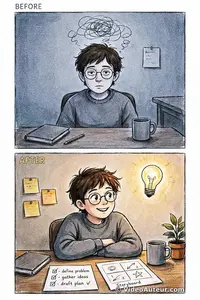
How do I come up with creative video ideas when I feel stuck
 How do I come up with creative video ideas when I feel stuck? Use brain dumps, constraints, and a simple idea bank to start filming today.
-
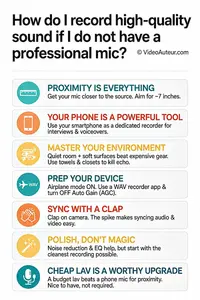
How do I record high-quality sound if I do not have a professional mic
How do I record high-quality sound if I do not have a professional mic? Discover simple, zero-budget techniques using your phone for studio-quality audio. -
What is B-roll and why does my video need it? A Guide
 Wondering what is B-roll and why does your video need it? This guide reveals simple tips to add visual variety, hide edits, and keep viewers watching longer.

Get Your Free Cheat Sheet
The Most Common Video Mistakes (and How to Fix Them)

Sign up to download it instantly. You’ll also get tips, step-by-step guidance, and gear guides to make video creation simple.
Copyright © 2014- VideoAuteur.com All rights reserved
This website does not sell any personal information.
Get Your Free Cheat Sheet
The Most Common Video Mistakes (and How to Fix Them)
Sign up to download it instantly. You’ll also get tips, step-by-step guidance, and gear guides to make video creation simple.