- Video Production
- Video Making Tips for Beginners
- How to become a videographer
- Practicality in Videography
Practicality in Videography: Your Story Matters More Than Gear
By Alvin Motilla and Jessica Motilla
Practicality in videography means prioritizing your story and skills over expensive gear.
Focus on expression, not impression.
Use what you can afford without debt, and master the tools you already own.
Remember, a compelling video comes from your creative vision -- not from the size of your camera or a maxed-out credit card.
Key Takeaways: How should one approach practicality in videography?
-
Prioritize Expression Over Impression: The goal of videography is telling a compelling story, not showcasing the most expensive equipment. Focus on what you can say with your camera, not what the camera says about your bank account.
-
Discipline Over Impulse (The P.A.C.E.S. Approach): Practicality is a deliberate practice. Before any purchase, pause to assess whether the item solves a real production problem or simply satisfies a temporary "shiny object" desire.
-
Financial Peace Fuels Creativity: The best gear is the gear you can afford without financial strain or debt. Staying debt-free provides more creative freedom than the stress of a high-interest payment on a new lens.
- Mindset is the Ultimate Upgrade: You can create amazing, professional-level work with the tools you already own. Shifting your internal narrative from "I need more to be good" to "I can do more with what I have" is the most cost-effective improvement you can make.
The transcript: What is practicality in videography?
Hey there! Let's talk about video gear. We all love it, right?
I mean, come on, we can't do without it!
But here's the thing: we all have limitations.
Maybe it's a budget, maybe it's time, or maybe it's just making sure the family's happy and healthy first.
So, when I see that super shiny, new piece of video gear, it's tempting for sure!
But I take a step back and ask myself:
Will it really serve my needs and fit within what I can really afford?
Because, we can't have it all. And that's okay!
But the key is being smart and practical when it comes to video gear.
We still can create amazing videos without spending a fortune, or going into debt for the coolest gizmos.
And we don't need to impress anyone -- especially not with gear! Are you with me?
Because at the end of the day, it's not about impressing anyone.
It's about expressing yourself through your videos.
So, what are your thoughts on video gear?
Memory Aid: Practicality in Videography
Theme: Express More, Spend Less
1. Core Definition
Practicality in videography = Choosing gear that fits your actual needs and budget, not chasing the latest tech to impress others.
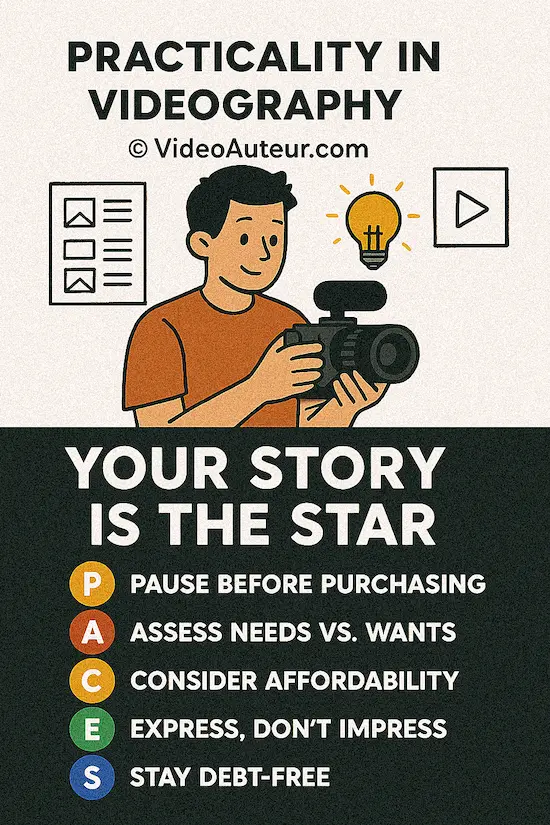
2. Key Principles (Mnemonic: P.A.C.E.S.)
| Letter | Principle | Quick Cue |
|---|---|---|
| P | Pause Before Purchasing | Step back, avoid impulse buys |
| A | Assess Needs vs. Wants | Does it solve a real problem? |
| C | Consider Affordability | Fits budget without strain |
| E | Express, Don't Impress | Story > shiny gear |
| S | Stay Debt-Free | No loans for "cool" equipment |
3. Action Steps
- 🛑 Pause when tempted by new gear
- 📝 Needs vs. Wants checklist before buying
- 💰 Budget-first mindset
- 🎯 Focus on storytelling over specs
- 🚫 Avoid debt for gear purchases
4. Mindset Shift
From: “I need the latest gear to be good.”
To: “I can create amazing videos with what I have.”
FAQs related to Practicality in Videography
What is the meaning of videography?
What is the meaning of videography?
Videography is the art and practice of recording moving images using a video camera or digital device.
It often includes capturing and editing video footage to tell a story or document events.
What is the purpose of videography?
What is the purpose of videography?
The main purpose of videography is to capture real-time events as they happen—like weddings, concerts, or interviews—preserving moments in motion for storytelling or documentation.
It is usually more spontaneous and less planned than filmmaking.
How many types of videography are there?
How many types of videography are there?
There are many types, including ...
- live event videography (weddings, concerts),
- cinematic videography,
- sports videography,
- travel videography, and
- animated or explainer videos.
Video styles range based on purpose and technique.
What is videography also known as?
What is videography also known as?
Videography is sometimes called video production or simply video recording.
It’s considered the digital counterpart to cinematography but usually on a smaller, more immediate scale.
What are the qualities of a videographer?
What are the qualities of a videographer?
A good videographer is ...
- creative,
- technically skilled,
- attentive to detail,
- patient,
- adaptable, and
- able to work under pressure.
Physical stamina and good communication skills are also important.
What are videography skills?
What are videography skills?
Key skills include ...
- camera operation,
- composition,
- lighting management,
- audio recording,
- video editing,
- creativity, and
- time management.
Also, soft skills--or "human skills"--like ...
- teamwork,
- communication, and
- marketing
... help a lot.
Is videography a technical skill?
Is videography a technical skill?
Yes, videography is a technical skill involving knowledge of cameras, lighting, sound equipment, and editing software.
It requires both technical know-how and artistic sensibility.
Is it hard to do videography?
Is it hard to do videography?
Videography can be challenging due to the need to capture quality footage in real-time, manage equipment, adapt to changing conditions, and edit footage effectively.
But with practice, beginners can improve steadily.
How can I practice and improve my videography skills?
How can I practice and improve my videography skills?
Practice by ...
- shooting regularly,
- learning your camera inside out,
- experimenting with lighting and composition,
- watching tutorials,
- editing your footage, and
- seeking feedback.
Join courses or communities for structured learning.
What are the rules in videography?
What are the rules in videography?
Basic rules include ...
- the rule of thirds for framing,
- proper lighting,
- steady camera work,
- clear audio, and
- smooth transitions.
Storytelling and pacing are also critical to keep viewers engaged.
What are the unexpected challenges of semi-professional videography?
What are the unexpected challenges of semi-professional videography?
Challenges include ...
- equipment failures,
- unpredictable lighting and weather,
- tight deadlines,
- client expectations, and
- managing shoots without large crews.
Adaptability and problem-solving are essential.
What is something you want beginner videographers to know?
What is something you want beginner videographers to know?
Owning expensive equipment doesn’t make you a great videographer.
- Learning how to use what you have,
- practicing consistently, and
- focusing on storytelling and editing skills
... matter far more.
You might like these
What Is Gear Acquisition Syndrome? Own Less, Create More
What Is Gear Acquisition Syndrome and how it sabotages video creators. Discover psychology behind GAS and practical steps to stop buying, start creating.
Ready to tell your story? Learn video production for beginners!
Learn free video production tips from Video Auteur! Discover the art of video creation. Craft your engaging piece.
What Are the Core Elements of Video Production Explained
What Are the Core Elements of Video Production explained. Discover why content and audience matter more than expensive equipment. Start here.

Alvin Motilla is the creator of VideoAuteur.com, where he helps everyday people make videos that truly connect with audiences. With over 20 years of experience spanning scriptwriting, documentaries, corporate, and freelance video production, he champions the human side of creation over gear obsession. A graduate of AB Mass Communication, he believes that showing up with heart matters more than owning expensive equipment. Off-screen, Alvin enjoys biking with his wife and daughter, staying active, and studying Scripture.

Join the
Video Auteur Club
Get tips, step-by-step guidance, and gear guides that make video production simple.
What's New


-
What is the Difference: Pre-Production, Production, Post-Production
 Confused by film terms? We explain what is the difference between pre-production, production, and post-production using a simple house-building analogy.
 -
What Type of Camera Should I Get as a Beginner?
 What type of camera should I get as a beginner? Learn which mirrorless cameras, features, and budget kits work best for video creators starting their journey.
 -
What is Digital Video Production? A Beginner's Complete Guide
 What is digital video production? Learn the basics, tools, and step-by-step process to create videos—from concept to sharing. Perfect for beginners!